Showing posts with label tip. Show all posts

Monday, 11 June 2007

Remember - Your Words Are Like Arrows...

When you are having a disagreement with a family member or friend its very easy to say something that YOU know will hurt them. Its like a weapon you use.

You don't REALLY mean it but you know that it will get to them.

You lash out.

Your hurt them.

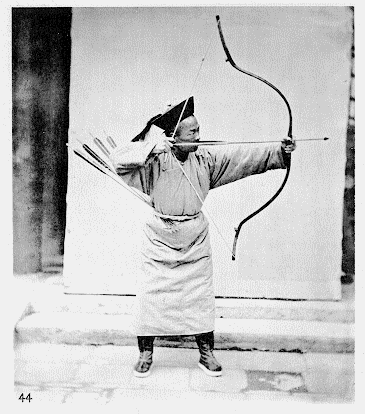
I would compare letting these hurtful words loose to firing an arrow at the person. You can't take the words back - once you've shot them That's it. Its too late.

The arrow remains in the person causing pain.

You can't take it back once you have loosed the arrow.

Be careful in what you say to people you love. Think of your words like arrows. You can't take them back and undo the hurt they have caused. With this in mind you might not be so quick to lash out.

Remember - Your Words Are Like Arrows...

When you are having a disagreement with a family member or friend its very easy to say something that YOU know will hurt them. Its like a weapon you use.

You don't REALLY mean it but you know that it will get to them.

You lash out.

Your hurt them.

I would compare letting these hurtful words loose to firing an arrow at the person. You can't take the words back - once you've shot them That's it. Its too late.

The arrow remains in the person causing pain.

You can't take it back once you have loosed the arrow.

Be careful in what you say to people you love. Think of your words like arrows. You can't take them back and undo the hurt they have caused. With this in mind you might not be so quick to lash out.

Wednesday, 9 May 2007

Top 5 Reasons Why Pencils are Environmentally Friendly


Tom Hodkinson wrote an article in the recent "Idler" about how using a pencil is environmentally friendly. It made me think and here are the reasons why I think a pencil is kinder to the environment than a pen.

1) All of the pencil is used.

Think about it. All the lead gets transferred to the paper in the form of writing and the wooden pencil sharpenings can be re-cycled or gathered together and dumped on the compost heap.

2) No plastic.

It is made of wood. The production of pencils can be sustainable by planting more trees. The "lead" in a pencil is not infact lead but finely ground graphite and clay powders. Although graphite is a mined ore and therefore a limited resource I believe that the enviromental impact of a pencil must still be a great deal less than a pen. I have never heard of a pencil tanker sinking in the ocean causing untold levels of pollution.

3) You can erase it.

Thus you will use less paper. No need for white out either.

4) It wont break.

Well the lead might break on you but all you need to do is sharpen it again. A pen's mechanics can break or the ink cartridge might burst. If a pen does burst it could ruin your shirt and thus cause more waste.

5) If you buy a non painted pencil then no colours used in the making of the pencil. Its all natural. A bit of wood and some graphite!

What do yo think? Do you think we should all be taking notes in pencil?

Top 5 Reasons Why Pencils are Environmentally Friendly


Tom Hodkinson wrote an article in the recent "Idler" about how using a pencil is environmentally friendly. It made me think and here are the reasons why I think a pencil is kinder to the environment than a pen.

1) All of the pencil is used.

Think about it. All the lead gets transferred to the paper in the form of writing and the wooden pencil sharpenings can be re-cycled or gathered together and dumped on the compost heap.

2) No plastic.

It is made of wood. The production of pencils can be sustainable by planting more trees. The "lead" in a pencil is not infact lead but finely ground graphite and clay powders. Although graphite is a mined ore and therefore a limited resource I believe that the enviromental impact of a pencil must still be a great deal less than a pen. I have never heard of a pencil tanker sinking in the ocean causing untold levels of pollution.

3) You can erase it.

Thus you will use less paper. No need for white out either.

4) It wont break.

Well the lead might break on you but all you need to do is sharpen it again. A pen's mechanics can break or the ink cartridge might burst. If a pen does burst it could ruin your shirt and thus cause more waste.

5) If you buy a non painted pencil then no colours used in the making of the pencil. Its all natural. A bit of wood and some graphite!

What do yo think? Do you think we should all be taking notes in pencil?

Friday, 13 April 2007

DON'T JUST SIT THERE - MOVE!

DON'T JUST SIT THERE - MOVE!
Photo By N. Ireland Wallpapers / Desktop Backgrounds


Quick tip for today:

While thinking about your posture at work - it is better to MOVE OFTEN than to SIT WELL.

Good Luck,
Allen

DON'T JUST SIT THERE - MOVE!

DON'T JUST SIT THERE - MOVE!
Photo By N. Ireland Wallpapers / Desktop Backgrounds


Quick tip for today:

While thinking about your posture at work - it is better to MOVE OFTEN than to SIT WELL.

Good Luck,
Allen

Tuesday, 10 April 2007

5 Tips on How to Manage Change in Your Life

5 Tips on How to Manage Change in Your Life

Photo By N. Ireland Wallpapers / Desktop Backgrounds


One of the most difficult aspects of life is handling change. Life is full of change. It could mean changing job, moving house, a new relationship, the ending of a relationship - you name it! It can be stressful but don't forget the golden rule! We can't just FEEL stressed without first THINKING about being stressed.

Here are some tips that I have gotten from self help books that have worked for ME.

1) Anticipate Change.
Change can be happening around you without you realising it! Try and anticipate change. Look at patterns or trends that are happening right now. Perhaps they may be a prelude or indicate an important change on the horizon. Let me give you an example. Here in Ireland, more and more Information Technology jobs are being moved to low cost environments in Asia. My job may be safe in the short term but is it really sustainable? What happens in a couple of years time? I can clearly see a trend so perhaps I should think about re-skilling into a profession that is not likely to be moved abroad? You get my point?

2) Plan for Change.
If we continue with the example of my kind of employment being moved to Asia - what can I do to plan for this inevitability? What options do I have? Perhaps I should think laterally or "outside the box". I have time now to adapt but how long do I have left? The way I see it one should think of planning for change like being in a game of chess. To be successful you need to be able see a few moves ahead. What are the consequences of your action today on the future? What are the consequences of INACTION on the future? What skills do I need to adapt? What are my priorities?

3) Overcome the Fear of Change.
In my experience, we humans fear change. We love being "stuck in a rut" so to speak. We get accustomed to the life we have today and get great comfort in the routine of the day to day tasks of our lives. Maybe we are adverse to taking risks equally you need to ask yourself "Am I taking a bigger risk by not changing?". Maybe we are afraid of the UNKNOWN. If this is so then we need to develop trust that everything will be ok. Look at past experiences? Has everything worked out in the end? When I knew it was time for me to move on from living in Sweden - I was afraid. I had my friends in Stockholm! I had spent 8 years of my life there. I was "used to" the way things were but I knew deep down it was time to change. I had to take the leap and trust everything was going to be OK.

4) Be Kind To Yourself During Change.
No matter how hard you try - you will most likely find change stressful. It seems to be the natural order of things. Try and be kind to yourself during times of change. Take care of your health - both physical and mental. With your physical health, take good care of your diet and make sure you get some exercise to burn of those stress hormones. For you mental health make sure you get enough sleep, enough relaxation and if you are spiritually inclined now is the time to draw on that part of your life.

5) Expect to make mistakes.
Finally - expect to make mistakes. When you are trying something new you are bound to make mistakes for the first while. When I passed my driving test I remember not only how nervous I was driving by myself but I remember how many mistakes I made. I also remember how much I learnt and an overall sense of freedom which was worth all the risks and hard work of trying to pass my driving test in a foreign country AND in a foreign language!

I hope you find these tips on managing change helpful. I certainly feel that if you take these five lessons on board you will manage change in your life. Well, perhaps better than you did before.

Good Luck,
Allen
5 Tips on How to Manage Change in Your Life

5 Tips on How to Manage Change in Your Life

Photo By N. Ireland Wallpapers / Desktop Backgrounds


One of the most difficult aspects of life is handling change. Life is full of change. It could mean changing job, moving house, a new relationship, the ending of a relationship - you name it! It can be stressful but don't forget the golden rule! We can't just FEEL stressed without first THINKING about being stressed.

Here are some tips that I have gotten from self help books that have worked for ME.

1) Anticipate Change.
Change can be happening around you without you realising it! Try and anticipate change. Look at patterns or trends that are happening right now. Perhaps they may be a prelude or indicate an important change on the horizon. Let me give you an example. Here in Ireland, more and more Information Technology jobs are being moved to low cost environments in Asia. My job may be safe in the short term but is it really sustainable? What happens in a couple of years time? I can clearly see a trend so perhaps I should think about re-skilling into a profession that is not likely to be moved abroad? You get my point?

2) Plan for Change.
If we continue with the example of my kind of employment being moved to Asia - what can I do to plan for this inevitability? What options do I have? Perhaps I should think laterally or "outside the box". I have time now to adapt but how long do I have left? The way I see it one should think of planning for change like being in a game of chess. To be successful you need to be able see a few moves ahead. What are the consequences of your action today on the future? What are the consequences of INACTION on the future? What skills do I need to adapt? What are my priorities?

3) Overcome the Fear of Change.
In my experience, we humans fear change. We love being "stuck in a rut" so to speak. We get accustomed to the life we have today and get great comfort in the routine of the day to day tasks of our lives. Maybe we are adverse to taking risks equally you need to ask yourself "Am I taking a bigger risk by not changing?". Maybe we are afraid of the UNKNOWN. If this is so then we need to develop trust that everything will be ok. Look at past experiences? Has everything worked out in the end? When I knew it was time for me to move on from living in Sweden - I was afraid. I had my friends in Stockholm! I had spent 8 years of my life there. I was "used to" the way things were but I knew deep down it was time to change. I had to take the leap and trust everything was going to be OK.

4) Be Kind To Yourself During Change.
No matter how hard you try - you will most likely find change stressful. It seems to be the natural order of things. Try and be kind to yourself during times of change. Take care of your health - both physical and mental. With your physical health, take good care of your diet and make sure you get some exercise to burn of those stress hormones. For you mental health make sure you get enough sleep, enough relaxation and if you are spiritually inclined now is the time to draw on that part of your life.

5) Expect to make mistakes.
Finally - expect to make mistakes. When you are trying something new you are bound to make mistakes for the first while. When I passed my driving test I remember not only how nervous I was driving by myself but I remember how many mistakes I made. I also remember how much I learnt and an overall sense of freedom which was worth all the risks and hard work of trying to pass my driving test in a foreign country AND in a foreign language!

I hope you find these tips on managing change helpful. I certainly feel that if you take these five lessons on board you will manage change in your life. Well, perhaps better than you did before.

Good Luck,
Allen

Tuesday, 6 March 2007

How to take Micropauses

Hi Everyone,
A micropause is a very short break that one can take when working at your desk or computer. It is a very important method of reducing the chances of developing an occupational injury at work. About a year ago I had to go on sick leave as my neck had frozen due to sitting at my desk for long periods without taking the appropriate breaks. A micropause need only be 20-30 secs and could involve looking away from your computer or carrying out some simple stretching exercises. I will write more on this later.

In the mean time check out http://www.cheqsoft.com/break.html . I have been using this tool and it really helps me manage the micropauses and longer breaks. I need something to FORCE me to take the breaks! The demo is free to download and as far as I can see you can keep using it without having to pay for it. Although you need to restart it daily to keep using it.

Give it a whirl and let me know what you think!

Allen

How to take Micropauses

Hi Everyone,
A micropause is a very short break that one can take when working at your desk or computer. It is a very important method of reducing the chances of developing an occupational injury at work. About a year ago I had to go on sick leave as my neck had frozen due to sitting at my desk for long periods without taking the appropriate breaks. A micropause need only be 20-30 secs and could involve looking away from your computer or carrying out some simple stretching exercises. I will write more on this later.

In the mean time check out http://www.cheqsoft.com/break.html . I have been using this tool and it really helps me manage the micropauses and longer breaks. I need something to FORCE me to take the breaks! The demo is free to download and as far as I can see you can keep using it without having to pay for it. Although you need to restart it daily to keep using it.

Give it a whirl and let me know what you think!

Allen

Friday, 2 March 2007

The Beginner's Mind.

Hi there,

This is a very useful technique when it comes to learning.

To quote wikipedia:

Shoshin (also pronounced nyuanshin) is a concept in Zen Buddhism meaning Beginner's Mind. It refers to having an attitude of openness, eagerness, and lack of preconceptions when studying a subject, even when studying at an advanced level, just as a beginner in that subject would. The term is especially used in the study of Zen Buddhism and Japanese martial arts.

The phrase was also used as the title of Zen teacher Shunryu Suzuki's book: Zen Mind, Beginner's Mind, which reflects a saying of his regarding the way to approach Zen practice: In the beginner's mind there are many possibilities, in the expert's mind there are few.


You can apply this in real life by approaching a subject with the mind of a beginner even if you feel you are already an expert! I remember such an example when I worked as a computer programmer. I had worked on a particular system for a few years and I really felt that "I knew it all". To be perfectly honest - I was a little bit arrogant about it! I then moved to another company who really pushed the system to it limits. I had a difficult time as I thought I knew it all and I was making lots of mistakes and my colleagues were surprised as they thought I knew it all too! If I had approached this new company with a "beginners mind", being honest with myself about what I actually knew, I would have caused less conflict and learnt much faster.

This technique can be applied in lots of areas of your life. Give it a go and you will be impressed by how much you will learn about the subject you are studying and yourself!

Good Luck,
Allen

The Beginner's Mind.

Hi there,

This is a very useful technique when it comes to learning.

To quote wikipedia:

Shoshin (also pronounced nyuanshin) is a concept in Zen Buddhism meaning Beginner's Mind. It refers to having an attitude of openness, eagerness, and lack of preconceptions when studying a subject, even when studying at an advanced level, just as a beginner in that subject would. The term is especially used in the study of Zen Buddhism and Japanese martial arts.

The phrase was also used as the title of Zen teacher Shunryu Suzuki's book: Zen Mind, Beginner's Mind, which reflects a saying of his regarding the way to approach Zen practice: In the beginner's mind there are many possibilities, in the expert's mind there are few.


You can apply this in real life by approaching a subject with the mind of a beginner even if you feel you are already an expert! I remember such an example when I worked as a computer programmer. I had worked on a particular system for a few years and I really felt that "I knew it all". To be perfectly honest - I was a little bit arrogant about it! I then moved to another company who really pushed the system to it limits. I had a difficult time as I thought I knew it all and I was making lots of mistakes and my colleagues were surprised as they thought I knew it all too! If I had approached this new company with a "beginners mind", being honest with myself about what I actually knew, I would have caused less conflict and learnt much faster.

This technique can be applied in lots of areas of your life. Give it a go and you will be impressed by how much you will learn about the subject you are studying and yourself!

Good Luck,
Allen

Thursday, 15 February 2007

A Simple Way to Re-generate our Cities...

Hi Everyone..

In the spirit of self help for lazy people here is a small tip I overheard someone talking about.

In order to brighten our environment - all we need to do is scatter seeds. When you go for a walk take some seeds with you - use seeds from a good hearty plant. Plant them among the weeds or in patches of waste land and wait and see what happens.

Simple but beautiful.

Allen

A Simple Way to Re-generate our Cities...

Hi Everyone..

In the spirit of self help for lazy people here is a small tip I overheard someone talking about.

In order to brighten our environment - all we need to do is scatter seeds. When you go for a walk take some seeds with you - use seeds from a good hearty plant. Plant them among the weeds or in patches of waste land and wait and see what happens.

Simple but beautiful.

Allen

Wednesday, 31 January 2007

A very effective relaxation technique - Alternate Nostril Breathing

About ten years ago I went on a Yoga course at the Scandinavian Yoga and Meditation School and was taught this relaxation technique.

I was a little skeptical at first but its a really effective way to calm frazzled nerves! I find it effective in that you are actually DOING something PHYSICAL rather than just some form of MENTAL relaxation. Meditation etc. can be very hard to do when you are feeling stressed and it is more something to do on a regular basis as a preventative measure against stress. I view Alternate Nostril Breathing as a first aid technique for a person who is ALREADY stressed. So look beyond the yogic mysticism and see a very effective relaxation technique.

This is what Holistic Online has to say about it:

If you don't do anything else, this is a simple yoga breathing exercise that can be done virtually anywhere, anyplace. You will be glad you did.!

With this exercise, we breathe through only one nostril at a time. The logic behind this exercise is that normal breathing does alternate from one nostril to the other at various times during the day.

Benefits

- The exercise produces optimum function to both sides of the brain: that is optimum creativity and optimum logical verbal activity. This also creates a more balanced person, since both halves of the brain are functioning property.

- The yogis consider this to be the best technique to calm the mind and the nervous system.

For details on how o do this exercise please visit HERE.

Good Luck!,
Allen

A very effective relaxation technique - Alternate Nostril Breathing

About ten years ago I went on a Yoga course at the Scandinavian Yoga and Meditation School and was taught this relaxation technique.

I was a little skeptical at first but its a really effective way to calm frazzled nerves! I find it effective in that you are actually DOING something PHYSICAL rather than just some form of MENTAL relaxation. Meditation etc. can be very hard to do when you are feeling stressed and it is more something to do on a regular basis as a preventative measure against stress. I view Alternate Nostril Breathing as a first aid technique for a person who is ALREADY stressed. So look beyond the yogic mysticism and see a very effective relaxation technique.

This is what Holistic Online has to say about it:

If you don't do anything else, this is a simple yoga breathing exercise that can be done virtually anywhere, anyplace. You will be glad you did.!

With this exercise, we breathe through only one nostril at a time. The logic behind this exercise is that normal breathing does alternate from one nostril to the other at various times during the day.

Benefits

- The exercise produces optimum function to both sides of the brain: that is optimum creativity and optimum logical verbal activity. This also creates a more balanced person, since both halves of the brain are functioning property.

- The yogis consider this to be the best technique to calm the mind and the nervous system.

For details on how o do this exercise please visit HERE.

Good Luck!,
Allen

Tuesday, 30 January 2007

Relax: Pretend You are on Vacation!

Without wishing to state the obvious, have you ever noticed how relaxed people are when they are on vacation! Have you noticed how they move and how they walk? They walk slowly. They amble along without a care in the world. People who are on vacation stroll leisurely along the beach in their shorts and flip flops, perhaps with a towel thrown over their shoulder.

Well, with this technique, it is all about how you walk. As you walk, imagine you are on vacation, slow down, stroll leisurely along as if you are at the beach. Imagine how you would feel if you were really chilled out and relaxed. Relax your shoulders and allow your limbs to go a little floppy. You can practice this while walking to the photocopier or on your breaks. Don't worry if it feels unnatural at first. Slowly but surely your body will get the idea and you will carry the feeling of relaxation into the rest of your daily activities.

Try it and see!

Allen

Relax: Pretend You are on Vacation!

Without wishing to state the obvious, have you ever noticed how relaxed people are when they are on vacation! Have you noticed how they move and how they walk? They walk slowly. They amble along without a care in the world. People who are on vacation stroll leisurely along the beach in their shorts and flip flops, perhaps with a towel thrown over their shoulder.

Well, with this technique, it is all about how you walk. As you walk, imagine you are on vacation, slow down, stroll leisurely along as if you are at the beach. Imagine how you would feel if you were really chilled out and relaxed. Relax your shoulders and allow your limbs to go a little floppy. You can practice this while walking to the photocopier or on your breaks. Don't worry if it feels unnatural at first. Slowly but surely your body will get the idea and you will carry the feeling of relaxation into the rest of your daily activities.

Try it and see!

Allen

Monday, 22 January 2007

Lifehack: Use a Spreadsheet to See Where Time is Going?


We all wonder where our time is going. In this lifehack for lazy people I suggest keeping a spreadsheet to clearly show how your time is being spent each day.

Here is how:

1) Create a table with days as columns and tasks as rows.

2) Create an extra column just after the list of tasks where you can assign a "weight" to a task. I use a scale of -3 to +3. Where -3 is awarded to a task that is very wasteful of your time e.g. mindless web surfing and +3 gets awarded to an important task that helps you towards your goals. Less important gets 2, less again gets 1 .. all the way down to -3.

3) Split your day column into two further columns one for the hours you worked on the task and a second calculated column that will be the result of :
TIME Worked on task X the weight.

4) Record the hours you spend on a task - and be honest - and let the spreadsheet calculate a score for the day. If you work eight hours per day and do nothing but the most important tasks all day that would be a top score of 24(8 hours times weight 3). Knowing this means you can calculate a daily productivity percentage. So if I scored only 12 points for a day then I was only 50% productive.


You can expand on this as much as you want e.g. using pie charts and trending graphs to clearly show where your time is going?

I have found this a great method of tracking where I spend my time and what I must do to improve my productivity.

Good Luck,
Allen

Lifehack: Use a Spreadsheet to See Where Time is Going?


We all wonder where our time is going. In this lifehack for lazy people I suggest keeping a spreadsheet to clearly show how your time is being spent each day.

Here is how:

1) Create a table with days as columns and tasks as rows.

2) Create an extra column just after the list of tasks where you can assign a "weight" to a task. I use a scale of -3 to +3. Where -3 is awarded to a task that is very wasteful of your time e.g. mindless web surfing and +3 gets awarded to an important task that helps you towards your goals. Less important gets 2, less again gets 1 .. all the way down to -3.

3) Split your day column into two further columns one for the hours you worked on the task and a second calculated column that will be the result of :
TIME Worked on task X the weight.

4) Record the hours you spend on a task - and be honest - and let the spreadsheet calculate a score for the day. If you work eight hours per day and do nothing but the most important tasks all day that would be a top score of 24(8 hours times weight 3). Knowing this means you can calculate a daily productivity percentage. So if I scored only 12 points for a day then I was only 50% productive.


You can expand on this as much as you want e.g. using pie charts and trending graphs to clearly show where your time is going?

I have found this a great method of tracking where I spend my time and what I must do to improve my productivity.

Good Luck,
Allen