Showing posts with label good habbits. Show all posts

Monday, 11 June 2007

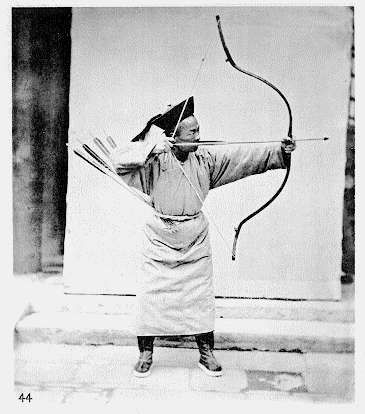
Remember - Your Words Are Like Arrows...

When you are having a disagreement with a family member or friend its very easy to say something that YOU know will hurt them. Its like a weapon you use.

You don't REALLY mean it but you know that it will get to them.

You lash out.

Your hurt them.

I would compare letting these hurtful words loose to firing an arrow at the person. You can't take the words back - once you've shot them That's it. Its too late.

The arrow remains in the person causing pain.

You can't take it back once you have loosed the arrow.

Be careful in what you say to people you love. Think of your words like arrows. You can't take them back and undo the hurt they have caused. With this in mind you might not be so quick to lash out.

Remember - Your Words Are Like Arrows...

When you are having a disagreement with a family member or friend its very easy to say something that YOU know will hurt them. Its like a weapon you use.

You don't REALLY mean it but you know that it will get to them.

You lash out.

Your hurt them.

I would compare letting these hurtful words loose to firing an arrow at the person. You can't take the words back - once you've shot them That's it. Its too late.

The arrow remains in the person causing pain.

You can't take it back once you have loosed the arrow.

Be careful in what you say to people you love. Think of your words like arrows. You can't take them back and undo the hurt they have caused. With this in mind you might not be so quick to lash out.

Wednesday, 18 April 2007

Self Created Obstacles to Change and How to Get Over Them.

When trying to develop or change yourself for the better, sometimes you find yourself with obstacles in your way. Now here is the thing. Some of those obstacles may have been put there by yourself. At least, that is what I have found.

So what reasons do we have for putting obstacles in our own way when it comes to changing ourselves? Well here are three reasons that I think are important to address when it comes to obstacles and personal change.

1) Secondary gains for staying the way we are.
Perhaps we get something from the way we are today - even though we think we want to change. Let us look an example. John has agoraphobia. It has developed over a period of time and now he is house bound. His wife loves him very much and she hates to see him this way and cares for him during his illness. John wants to change but at the same time doesn't do the anything to help himself change. He doesn't even try. A psychologist might say that John enjoys the attention he gets from having this condition or he enjoys being mothered and looked after. In psychology, this is called a secondary gain.

Do you have any secondary gains preventing you changing for the better? Ask yourself what is more important to you? Is this change worth more to you than the secondary gains?

2) You have a fear of failure.
Again let us use an example to help describe this self created obstacle. Peter hates his job. He feels lonely, isolated and the people he works with seem to be all self-serving rats in a rat race. Despite all this, his job is relatively secure and well paid. He has a family to provide for and a mortgage to pay. He feels secure. As time goes by his mental health begins to suffer - he starts to feel depressed and he has more arguments with his spouse. Yet he is afraid to change job. He is afraid of the unknown. He thinks the worst might happen i.e. that if he goes to another company he will not be able to do his job as well and he will get fired, he will loose his home and everything he ever worked for. He feels trapped.

Living under the burden of fear is a terrible thing but it is a very easy state to find yourself in. Especially in today's society. Ask yourself if fear is stopping you from changing for the better. Ask yourself - is your mental health suffering from staying where you are now? Look at past experiences of change in your life - the last time you changed job, was it really that bad?

3) You are letting perfectionism stop you from action.
Are you waiting for the right moment to change? Are you waiting for the right conditions to change? Do you want to be able to do these new things perfectly and don't want to start doing them until you feel you can do them perfectly? Remember things don't have to be perfect for you to change NOW. Are you telling yourself "I will change job when I feel more settled in my home?" or "I want my C.V. to be perfect before applying for my DREAM job!" then you discover these PERFECT times never come and you have missed your opportunities? Stop and ask yourself has perfectionism stopped YOU from progressing.


SOLUTION:
How do you know if I am putting obstacles in my way? Well you ANALYSE, ANALYSE, ANALYSE your thoughts and motivations! Here is how:

- Question your motives for NOT changing.
- What are your motives FOR changing?
- List out your life priorities. Take your time and work out what is important for you in this life and what you want to change?
- List out what things you have done right to reach your goals.
- Ask yourself WHY you haven't changed? Pretend your are being interviewed by a hard hitting newsperson. Write out how the dialogue might go between you and the journalist. How would they question your answers?
- After the imaginary journalist has finished with you - do you have any valid reasons left for not changing?

The main theme behind all this questioning is being honest with yourself. You may be surprised by how many obstacles YOU are putting in your way and once you realise this - it will become much easier to LEAP OVER THEM!

Good Luck,
Allen

Self Created Obstacles to Change and How to Get Over Them.

When trying to develop or change yourself for the better, sometimes you find yourself with obstacles in your way. Now here is the thing. Some of those obstacles may have been put there by yourself. At least, that is what I have found.

So what reasons do we have for putting obstacles in our own way when it comes to changing ourselves? Well here are three reasons that I think are important to address when it comes to obstacles and personal change.

1) Secondary gains for staying the way we are.
Perhaps we get something from the way we are today - even though we think we want to change. Let us look an example. John has agoraphobia. It has developed over a period of time and now he is house bound. His wife loves him very much and she hates to see him this way and cares for him during his illness. John wants to change but at the same time doesn't do the anything to help himself change. He doesn't even try. A psychologist might say that John enjoys the attention he gets from having this condition or he enjoys being mothered and looked after. In psychology, this is called a secondary gain.

Do you have any secondary gains preventing you changing for the better? Ask yourself what is more important to you? Is this change worth more to you than the secondary gains?

2) You have a fear of failure.
Again let us use an example to help describe this self created obstacle. Peter hates his job. He feels lonely, isolated and the people he works with seem to be all self-serving rats in a rat race. Despite all this, his job is relatively secure and well paid. He has a family to provide for and a mortgage to pay. He feels secure. As time goes by his mental health begins to suffer - he starts to feel depressed and he has more arguments with his spouse. Yet he is afraid to change job. He is afraid of the unknown. He thinks the worst might happen i.e. that if he goes to another company he will not be able to do his job as well and he will get fired, he will loose his home and everything he ever worked for. He feels trapped.

Living under the burden of fear is a terrible thing but it is a very easy state to find yourself in. Especially in today's society. Ask yourself if fear is stopping you from changing for the better. Ask yourself - is your mental health suffering from staying where you are now? Look at past experiences of change in your life - the last time you changed job, was it really that bad?

3) You are letting perfectionism stop you from action.
Are you waiting for the right moment to change? Are you waiting for the right conditions to change? Do you want to be able to do these new things perfectly and don't want to start doing them until you feel you can do them perfectly? Remember things don't have to be perfect for you to change NOW. Are you telling yourself "I will change job when I feel more settled in my home?" or "I want my C.V. to be perfect before applying for my DREAM job!" then you discover these PERFECT times never come and you have missed your opportunities? Stop and ask yourself has perfectionism stopped YOU from progressing.


SOLUTION:
How do you know if I am putting obstacles in my way? Well you ANALYSE, ANALYSE, ANALYSE your thoughts and motivations! Here is how:

- Question your motives for NOT changing.
- What are your motives FOR changing?
- List out your life priorities. Take your time and work out what is important for you in this life and what you want to change?
- List out what things you have done right to reach your goals.
- Ask yourself WHY you haven't changed? Pretend your are being interviewed by a hard hitting newsperson. Write out how the dialogue might go between you and the journalist. How would they question your answers?
- After the imaginary journalist has finished with you - do you have any valid reasons left for not changing?

The main theme behind all this questioning is being honest with yourself. You may be surprised by how many obstacles YOU are putting in your way and once you realise this - it will become much easier to LEAP OVER THEM!

Good Luck,
Allen

Tuesday, 10 April 2007

Even Without a Garden You Can Grow Your Own Potatoes!

Even Without a Garden You Can Grow Your Own Potatoes!

In this day of people trying to be more organic or more "green" - this is a great way of making a small step towards being more organic.

There are a couple of ways you can do this if you are short of space or have no garden. This is the way I am growing potatoes this spring.

- Take a fertilizer bag or any large strong bag. My bags are about 100 litres in size. Put some holes at the bottom of the bag for drainage.

- Half fill the bag with general purpose compost.

- Roll down the bag until the top of the bag is a centimetre or so above the compost.

- Take two seed potatoes (try the salad type which will be harvested in June/July).

- Plant these potatoes eyes up. The eyes are the little sprouts of shoots that should be coming out of the seed potato. If your seed potato has not got any shoots then set them on a tray near a window and wait until some shoots appear.

- Place them just below the surface.

- Water gently - not too much as you don't want to rot the budding shoots.

- As the plant grows you are going to roll the bag a bit up at a time and add more compost. Don't forget to water weekly and feed with some plant food.

- When the plant flowers then its time to harvest. Simple rummage through the bag for your lovely spuds!

Repeat for as many bags as you want.

Now I haven't done this before so I will keep you posted on how it goes. Apparently this method works and is a great way to have your own potatoes!

Another way of growing potatoes when you don't have the space is to use a "Potato Barrel" - as shown in image above.

Here is the method for working with the barrel.


Planting

You need 80 Litres of a good general purpose compost. Pour 6in. of compost into the bottom of the barrel and plant 5 seed potatoes (shoots or eyes uppermost), about 2in. deep. Position one potato in the centre and the other 4 in opposite corners. Do not soak the compost at this stage as this may rot the tubers. When the shoots have grown about 6in. high, add a second layer of compost around the plants, exposing just the tips. Repeat this process in layers of about 4in. until the compost and the shoots reach 1in. below the top of the barrel.

As the main stem grows towards the top of the barrel, it sends out potato-bearing side shoots all the way up, eventually producing 'new' potatoes. Potato foliage continues to grow until it is 1-2ft above the top of the barrel.

Watering and Feeding

Once the plants are well established the compost needs weekly watering and feeding with a high potash/low nitrogen soluble plant food (eg. a propriety tomato fertiliser). Do not skimp on feed and water as potatoes are greedy, especially when in a tub.

Harvesting

Eventually the plants produce tiny white or pink flowers. This is the time when potatoes should be ready to harvest. Lift the sliders in the barrel sides. The compost should be held in place by the tightly packed roots. If the potatoes are big enough, ease them out. The potatoes will keep on growing until you have harvested the whole barrel.


Let me know how it goes if you choose to do this!

Allen

Even Without a Garden You Can Grow Your Own Potatoes!

Even Without a Garden You Can Grow Your Own Potatoes!

In this day of people trying to be more organic or more "green" - this is a great way of making a small step towards being more organic.

There are a couple of ways you can do this if you are short of space or have no garden. This is the way I am growing potatoes this spring.

- Take a fertilizer bag or any large strong bag. My bags are about 100 litres in size. Put some holes at the bottom of the bag for drainage.

- Half fill the bag with general purpose compost.

- Roll down the bag until the top of the bag is a centimetre or so above the compost.

- Take two seed potatoes (try the salad type which will be harvested in June/July).

- Plant these potatoes eyes up. The eyes are the little sprouts of shoots that should be coming out of the seed potato. If your seed potato has not got any shoots then set them on a tray near a window and wait until some shoots appear.

- Place them just below the surface.

- Water gently - not too much as you don't want to rot the budding shoots.

- As the plant grows you are going to roll the bag a bit up at a time and add more compost. Don't forget to water weekly and feed with some plant food.

- When the plant flowers then its time to harvest. Simple rummage through the bag for your lovely spuds!

Repeat for as many bags as you want.

Now I haven't done this before so I will keep you posted on how it goes. Apparently this method works and is a great way to have your own potatoes!

Another way of growing potatoes when you don't have the space is to use a "Potato Barrel" - as shown in image above.

Here is the method for working with the barrel.


Planting

You need 80 Litres of a good general purpose compost. Pour 6in. of compost into the bottom of the barrel and plant 5 seed potatoes (shoots or eyes uppermost), about 2in. deep. Position one potato in the centre and the other 4 in opposite corners. Do not soak the compost at this stage as this may rot the tubers. When the shoots have grown about 6in. high, add a second layer of compost around the plants, exposing just the tips. Repeat this process in layers of about 4in. until the compost and the shoots reach 1in. below the top of the barrel.

As the main stem grows towards the top of the barrel, it sends out potato-bearing side shoots all the way up, eventually producing 'new' potatoes. Potato foliage continues to grow until it is 1-2ft above the top of the barrel.

Watering and Feeding

Once the plants are well established the compost needs weekly watering and feeding with a high potash/low nitrogen soluble plant food (eg. a propriety tomato fertiliser). Do not skimp on feed and water as potatoes are greedy, especially when in a tub.

Harvesting

Eventually the plants produce tiny white or pink flowers. This is the time when potatoes should be ready to harvest. Lift the sliders in the barrel sides. The compost should be held in place by the tightly packed roots. If the potatoes are big enough, ease them out. The potatoes will keep on growing until you have harvested the whole barrel.


Let me know how it goes if you choose to do this!

Allen

5 Tips on How to Manage Change in Your Life

5 Tips on How to Manage Change in Your Life

Photo By N. Ireland Wallpapers / Desktop Backgrounds


One of the most difficult aspects of life is handling change. Life is full of change. It could mean changing job, moving house, a new relationship, the ending of a relationship - you name it! It can be stressful but don't forget the golden rule! We can't just FEEL stressed without first THINKING about being stressed.

Here are some tips that I have gotten from self help books that have worked for ME.

1) Anticipate Change.
Change can be happening around you without you realising it! Try and anticipate change. Look at patterns or trends that are happening right now. Perhaps they may be a prelude or indicate an important change on the horizon. Let me give you an example. Here in Ireland, more and more Information Technology jobs are being moved to low cost environments in Asia. My job may be safe in the short term but is it really sustainable? What happens in a couple of years time? I can clearly see a trend so perhaps I should think about re-skilling into a profession that is not likely to be moved abroad? You get my point?

2) Plan for Change.
If we continue with the example of my kind of employment being moved to Asia - what can I do to plan for this inevitability? What options do I have? Perhaps I should think laterally or "outside the box". I have time now to adapt but how long do I have left? The way I see it one should think of planning for change like being in a game of chess. To be successful you need to be able see a few moves ahead. What are the consequences of your action today on the future? What are the consequences of INACTION on the future? What skills do I need to adapt? What are my priorities?

3) Overcome the Fear of Change.
In my experience, we humans fear change. We love being "stuck in a rut" so to speak. We get accustomed to the life we have today and get great comfort in the routine of the day to day tasks of our lives. Maybe we are adverse to taking risks equally you need to ask yourself "Am I taking a bigger risk by not changing?". Maybe we are afraid of the UNKNOWN. If this is so then we need to develop trust that everything will be ok. Look at past experiences? Has everything worked out in the end? When I knew it was time for me to move on from living in Sweden - I was afraid. I had my friends in Stockholm! I had spent 8 years of my life there. I was "used to" the way things were but I knew deep down it was time to change. I had to take the leap and trust everything was going to be OK.

4) Be Kind To Yourself During Change.
No matter how hard you try - you will most likely find change stressful. It seems to be the natural order of things. Try and be kind to yourself during times of change. Take care of your health - both physical and mental. With your physical health, take good care of your diet and make sure you get some exercise to burn of those stress hormones. For you mental health make sure you get enough sleep, enough relaxation and if you are spiritually inclined now is the time to draw on that part of your life.

5) Expect to make mistakes.
Finally - expect to make mistakes. When you are trying something new you are bound to make mistakes for the first while. When I passed my driving test I remember not only how nervous I was driving by myself but I remember how many mistakes I made. I also remember how much I learnt and an overall sense of freedom which was worth all the risks and hard work of trying to pass my driving test in a foreign country AND in a foreign language!

I hope you find these tips on managing change helpful. I certainly feel that if you take these five lessons on board you will manage change in your life. Well, perhaps better than you did before.

Good Luck,
Allen

5 Tips on How to Manage Change in Your Life

5 Tips on How to Manage Change in Your Life

Photo By N. Ireland Wallpapers / Desktop Backgrounds


One of the most difficult aspects of life is handling change. Life is full of change. It could mean changing job, moving house, a new relationship, the ending of a relationship - you name it! It can be stressful but don't forget the golden rule! We can't just FEEL stressed without first THINKING about being stressed.

Here are some tips that I have gotten from self help books that have worked for ME.

1) Anticipate Change.
Change can be happening around you without you realising it! Try and anticipate change. Look at patterns or trends that are happening right now. Perhaps they may be a prelude or indicate an important change on the horizon. Let me give you an example. Here in Ireland, more and more Information Technology jobs are being moved to low cost environments in Asia. My job may be safe in the short term but is it really sustainable? What happens in a couple of years time? I can clearly see a trend so perhaps I should think about re-skilling into a profession that is not likely to be moved abroad? You get my point?

2) Plan for Change.
If we continue with the example of my kind of employment being moved to Asia - what can I do to plan for this inevitability? What options do I have? Perhaps I should think laterally or "outside the box". I have time now to adapt but how long do I have left? The way I see it one should think of planning for change like being in a game of chess. To be successful you need to be able see a few moves ahead. What are the consequences of your action today on the future? What are the consequences of INACTION on the future? What skills do I need to adapt? What are my priorities?

3) Overcome the Fear of Change.
In my experience, we humans fear change. We love being "stuck in a rut" so to speak. We get accustomed to the life we have today and get great comfort in the routine of the day to day tasks of our lives. Maybe we are adverse to taking risks equally you need to ask yourself "Am I taking a bigger risk by not changing?". Maybe we are afraid of the UNKNOWN. If this is so then we need to develop trust that everything will be ok. Look at past experiences? Has everything worked out in the end? When I knew it was time for me to move on from living in Sweden - I was afraid. I had my friends in Stockholm! I had spent 8 years of my life there. I was "used to" the way things were but I knew deep down it was time to change. I had to take the leap and trust everything was going to be OK.

4) Be Kind To Yourself During Change.
No matter how hard you try - you will most likely find change stressful. It seems to be the natural order of things. Try and be kind to yourself during times of change. Take care of your health - both physical and mental. With your physical health, take good care of your diet and make sure you get some exercise to burn of those stress hormones. For you mental health make sure you get enough sleep, enough relaxation and if you are spiritually inclined now is the time to draw on that part of your life.

5) Expect to make mistakes.
Finally - expect to make mistakes. When you are trying something new you are bound to make mistakes for the first while. When I passed my driving test I remember not only how nervous I was driving by myself but I remember how many mistakes I made. I also remember how much I learnt and an overall sense of freedom which was worth all the risks and hard work of trying to pass my driving test in a foreign country AND in a foreign language!

I hope you find these tips on managing change helpful. I certainly feel that if you take these five lessons on board you will manage change in your life. Well, perhaps better than you did before.

Good Luck,
Allen

Tuesday, 6 March 2007

How to take Micropauses

Hi Everyone,
A micropause is a very short break that one can take when working at your desk or computer. It is a very important method of reducing the chances of developing an occupational injury at work. About a year ago I had to go on sick leave as my neck had frozen due to sitting at my desk for long periods without taking the appropriate breaks. A micropause need only be 20-30 secs and could involve looking away from your computer or carrying out some simple stretching exercises. I will write more on this later.

In the mean time check out http://www.cheqsoft.com/break.html . I have been using this tool and it really helps me manage the micropauses and longer breaks. I need something to FORCE me to take the breaks! The demo is free to download and as far as I can see you can keep using it without having to pay for it. Although you need to restart it daily to keep using it.

Give it a whirl and let me know what you think!

Allen

How to take Micropauses

Hi Everyone,
A micropause is a very short break that one can take when working at your desk or computer. It is a very important method of reducing the chances of developing an occupational injury at work. About a year ago I had to go on sick leave as my neck had frozen due to sitting at my desk for long periods without taking the appropriate breaks. A micropause need only be 20-30 secs and could involve looking away from your computer or carrying out some simple stretching exercises. I will write more on this later.

In the mean time check out http://www.cheqsoft.com/break.html . I have been using this tool and it really helps me manage the micropauses and longer breaks. I need something to FORCE me to take the breaks! The demo is free to download and as far as I can see you can keep using it without having to pay for it. Although you need to restart it daily to keep using it.

Give it a whirl and let me know what you think!

Allen

How to Handle Aging or How not to become like the actors in Star Trek ..

Someone sent this to me today and I thought I would share it with you ...

George Carlin's Views on Aging

Do you realize that the only time in our lives when we like to get old is when we're kids? If you're less than 10 years old, you're so excited about aging that you think in fractions.

"How old are you?" "I'm four and a half!" You're never thirty-six and a half. You're four and a half, going on five! That's the key

You get into your teens, now they can't hold you back. You jump to the next number, or even a few ahead.

"How old are you?" "I'm gonna be 16!" You could be 13, but hey, you're gonna be 16! And then the greatest day of your life . . . you become 21. Even the words sound like a ceremony . YOU BECOME 21. YESSSS!!!

But then you turn 30. Oooohh, what happened there? Makes you sound like bad milk! He TURNED ; we had to throw him out. There's no fun now, you're Just a sour-dumpling. What's wrong? What's changed?

You BECOME 21, you TURN 30, then you're PUSHING 40. Whoa! Put on the brakes, it's all slipping away. Before you know it, you REACH 50 and your dreams are gone

But wait!!! You MAKE it to 60. You didn't think you would!

So you BECOME 21, TURN 30, PUSH 40, REACH 50 and MAKE it to 60.

You've built up so much speed that you HIT 70! After that it's a day-by-day thing; you HIT !

You get into your 80s and every day is a complete cycle; you HIT lunch; you TURN 4:30; you REACH bedtime And it doesn't end there. Into the 90s, you start going backwards; "I Was JUST 92."

Then a strange thing happens. If you make it over 100, you become a little kid again. "I'm 100 and a half!"
May you all make it to a healthy 100 and a half!!


HOW TO STAY YOUNG
1.. Throw out nonessential numbers. This includes age, weight and height. Let the doctors worry about them. That is why you pay "them"

2. Keep only cheerful friends .. The grouches pull you down.

3. Keep learning. Learn more about the computer , crafts, gardening , whatever. Never let the brain idle. "An idle mind is the devil's workshop." And the devil's name is Alzheimer's.

4. Enjoy the simple things.

5. Laugh often, long and loud . Laugh until you gasp for breath.

6. The tears happen. Endure, grieve, and move on. The only person, who is with us our entire life, is ourselves. Be ALIVE while you are alive.

7. Surround yourself with what you love, whether it's family, pets, keepsakes, music , plants, hobbies , whatever. Your home is your refuge.

8. Cherish your health: If it is good, preserve it. If it is unstable,improve it. If it is beyond what you can improve, get help.

9 Don't take guilt trips .. Take a trip to the mall, even to the next county; to a foreign country but NOT to where the guilt is.

10.Tell the people you love that you love them, at every opportunity.


AND ALWAYS REMEMBER:
Life is not measured by the number of breaths we take, but by the moments that take our breath away ..


And if you don 't send this to at least 8 people - who cares! But do share this with someone. We all need to live life to its fullest each day!!


--------------------------------------------------------------------------------
How to Handle Aging or How not to become like the actors in Star Trek ..

Someone sent this to me today and I thought I would share it with you ...

George Carlin's Views on Aging

Do you realize that the only time in our lives when we like to get old is when we're kids? If you're less than 10 years old, you're so excited about aging that you think in fractions.

"How old are you?" "I'm four and a half!" You're never thirty-six and a half. You're four and a half, going on five! That's the key

You get into your teens, now they can't hold you back. You jump to the next number, or even a few ahead.

"How old are you?" "I'm gonna be 16!" You could be 13, but hey, you're gonna be 16! And then the greatest day of your life . . . you become 21. Even the words sound like a ceremony . YOU BECOME 21. YESSSS!!!

But then you turn 30. Oooohh, what happened there? Makes you sound like bad milk! He TURNED ; we had to throw him out. There's no fun now, you're Just a sour-dumpling. What's wrong? What's changed?

You BECOME 21, you TURN 30, then you're PUSHING 40. Whoa! Put on the brakes, it's all slipping away. Before you know it, you REACH 50 and your dreams are gone

But wait!!! You MAKE it to 60. You didn't think you would!

So you BECOME 21, TURN 30, PUSH 40, REACH 50 and MAKE it to 60.

You've built up so much speed that you HIT 70! After that it's a day-by-day thing; you HIT !

You get into your 80s and every day is a complete cycle; you HIT lunch; you TURN 4:30; you REACH bedtime And it doesn't end there. Into the 90s, you start going backwards; "I Was JUST 92."

Then a strange thing happens. If you make it over 100, you become a little kid again. "I'm 100 and a half!"
May you all make it to a healthy 100 and a half!!


HOW TO STAY YOUNG
1.. Throw out nonessential numbers. This includes age, weight and height. Let the doctors worry about them. That is why you pay "them"

2. Keep only cheerful friends .. The grouches pull you down.

3. Keep learning. Learn more about the computer , crafts, gardening , whatever. Never let the brain idle. "An idle mind is the devil's workshop." And the devil's name is Alzheimer's.

4. Enjoy the simple things.

5. Laugh often, long and loud . Laugh until you gasp for breath.

6. The tears happen. Endure, grieve, and move on. The only person, who is with us our entire life, is ourselves. Be ALIVE while you are alive.

7. Surround yourself with what you love, whether it's family, pets, keepsakes, music , plants, hobbies , whatever. Your home is your refuge.

8. Cherish your health: If it is good, preserve it. If it is unstable,improve it. If it is beyond what you can improve, get help.

9 Don't take guilt trips .. Take a trip to the mall, even to the next county; to a foreign country but NOT to where the guilt is.

10.Tell the people you love that you love them, at every opportunity.


AND ALWAYS REMEMBER:
Life is not measured by the number of breaths we take, but by the moments that take our breath away ..


And if you don 't send this to at least 8 people - who cares! But do share this with someone. We all need to live life to its fullest each day!!


--------------------------------------------------------------------------------

Friday, 2 March 2007

The Beginner's Mind.

Hi there,

This is a very useful technique when it comes to learning.

To quote wikipedia:

Shoshin (also pronounced nyuanshin) is a concept in Zen Buddhism meaning Beginner's Mind. It refers to having an attitude of openness, eagerness, and lack of preconceptions when studying a subject, even when studying at an advanced level, just as a beginner in that subject would. The term is especially used in the study of Zen Buddhism and Japanese martial arts.

The phrase was also used as the title of Zen teacher Shunryu Suzuki's book: Zen Mind, Beginner's Mind, which reflects a saying of his regarding the way to approach Zen practice: In the beginner's mind there are many possibilities, in the expert's mind there are few.


You can apply this in real life by approaching a subject with the mind of a beginner even if you feel you are already an expert! I remember such an example when I worked as a computer programmer. I had worked on a particular system for a few years and I really felt that "I knew it all". To be perfectly honest - I was a little bit arrogant about it! I then moved to another company who really pushed the system to it limits. I had a difficult time as I thought I knew it all and I was making lots of mistakes and my colleagues were surprised as they thought I knew it all too! If I had approached this new company with a "beginners mind", being honest with myself about what I actually knew, I would have caused less conflict and learnt much faster.

This technique can be applied in lots of areas of your life. Give it a go and you will be impressed by how much you will learn about the subject you are studying and yourself!

Good Luck,
Allen

The Beginner's Mind.

Hi there,

This is a very useful technique when it comes to learning.

To quote wikipedia:

Shoshin (also pronounced nyuanshin) is a concept in Zen Buddhism meaning Beginner's Mind. It refers to having an attitude of openness, eagerness, and lack of preconceptions when studying a subject, even when studying at an advanced level, just as a beginner in that subject would. The term is especially used in the study of Zen Buddhism and Japanese martial arts.

The phrase was also used as the title of Zen teacher Shunryu Suzuki's book: Zen Mind, Beginner's Mind, which reflects a saying of his regarding the way to approach Zen practice: In the beginner's mind there are many possibilities, in the expert's mind there are few.


You can apply this in real life by approaching a subject with the mind of a beginner even if you feel you are already an expert! I remember such an example when I worked as a computer programmer. I had worked on a particular system for a few years and I really felt that "I knew it all". To be perfectly honest - I was a little bit arrogant about it! I then moved to another company who really pushed the system to it limits. I had a difficult time as I thought I knew it all and I was making lots of mistakes and my colleagues were surprised as they thought I knew it all too! If I had approached this new company with a "beginners mind", being honest with myself about what I actually knew, I would have caused less conflict and learnt much faster.

This technique can be applied in lots of areas of your life. Give it a go and you will be impressed by how much you will learn about the subject you are studying and yourself!

Good Luck,
Allen

Friday, 23 February 2007

How To Stop All or Nothing Thinking - Speak in E-Prime

Hi there,

Many people find all or nothing thinking - also known as binary thinking - a common issue when dealing with cognitive distortions.

I have noted that many people find that speaking in E-Prime may reduce the tendency to label situations and people into certain categories.

From Wikipedia:

E- Prime attempts to remove the verb “to be” in all its forms from English: be, is, am, are, was, were, been and being, plus all the contractions. This has the tactical effect of eliminating the passive voice. According to proponents, it forces the writer (or speaker) to think differently, and often results in language that most people find easier to read. Some call E-Prime a variant of the English language, while others approach it like a mental discipline to filter their own speech and translate the speech of others. For example, the grammatical construct changes “The movie was good.” to “I liked the movie.” Telling someone “the movie was good” imparts the state of goodness to the movie, rather than communicating the subjective nature of one's experience of the movie.


E-Prime forces a writer to choose verbs and meanings carefully: the elimination of "to be" implicitly eliminates the passive voice and progressive aspect. Some defective verbs, such as "can", use paraphrases involving "to be" in some tenses and moods. This constraint alone accounts for much of the appeal of E-Prime to some of its advocates, since many stylists argue that such constructions occur too frequently in sloppy English writing. Of course it may also generate difficulties for some writers as they learn to use E-Prime.


An example of how E-Prime might work.

So the short poem:

Roses are red;
Violets are blue.
Honey is sweet,
And so are you.

One possible translation in E-prime:

Roses appear red;
Violets seem blue.
Honey tastes sweet,
And you please me too.

To use this tip, simply eliminate all uses of the verb "to be" from your communication for a given period of time, whether an hour, a day, or the time it takes you to write an email that you fear will turn into a flame.

I have indeed found this technique useful when I wish to speak in a diplomatic tone such as in a meeting

In my experience - I have found this technique useful to illustrate how people possibly label situations by using words such as:

be
being
been
am
is; isn't
are; aren't
was; wasn't
were; weren't

An example:

"That is a spaceship!"

In E-prime:
"That certainly looks like a spaceship to me." (Implication: it merits further investigation. What does it look like to you?)

You could go to http://en.wikipedia.org/wiki/E-prime as a place to learn more about E-Prime.

Good Luck,

Allen

P.S. I wrote this article entirely in E-Prime, except for the examples.

How To Stop All or Nothing Thinking - Speak in E-Prime

Hi there,

Many people find all or nothing thinking - also known as binary thinking - a common issue when dealing with cognitive distortions.

I have noted that many people find that speaking in E-Prime may reduce the tendency to label situations and people into certain categories.

From Wikipedia:

E- Prime attempts to remove the verb “to be” in all its forms from English: be, is, am, are, was, were, been and being, plus all the contractions. This has the tactical effect of eliminating the passive voice. According to proponents, it forces the writer (or speaker) to think differently, and often results in language that most people find easier to read. Some call E-Prime a variant of the English language, while others approach it like a mental discipline to filter their own speech and translate the speech of others. For example, the grammatical construct changes “The movie was good.” to “I liked the movie.” Telling someone “the movie was good” imparts the state of goodness to the movie, rather than communicating the subjective nature of one's experience of the movie.


E-Prime forces a writer to choose verbs and meanings carefully: the elimination of "to be" implicitly eliminates the passive voice and progressive aspect. Some defective verbs, such as "can", use paraphrases involving "to be" in some tenses and moods. This constraint alone accounts for much of the appeal of E-Prime to some of its advocates, since many stylists argue that such constructions occur too frequently in sloppy English writing. Of course it may also generate difficulties for some writers as they learn to use E-Prime.


An example of how E-Prime might work.

So the short poem:

Roses are red;
Violets are blue.
Honey is sweet,
And so are you.

One possible translation in E-prime:

Roses appear red;
Violets seem blue.
Honey tastes sweet,
And you please me too.

To use this tip, simply eliminate all uses of the verb "to be" from your communication for a given period of time, whether an hour, a day, or the time it takes you to write an email that you fear will turn into a flame.

I have indeed found this technique useful when I wish to speak in a diplomatic tone such as in a meeting

In my experience - I have found this technique useful to illustrate how people possibly label situations by using words such as:

be
being
been
am
is; isn't
are; aren't
was; wasn't
were; weren't

An example:

"That is a spaceship!"

In E-prime:
"That certainly looks like a spaceship to me." (Implication: it merits further investigation. What does it look like to you?)

You could go to http://en.wikipedia.org/wiki/E-prime as a place to learn more about E-Prime.

Good Luck,

Allen

P.S. I wrote this article entirely in E-Prime, except for the examples.

Thursday, 15 February 2007

A Simple Way to Re-generate our Cities...

Hi Everyone..

In the spirit of self help for lazy people here is a small tip I overheard someone talking about.

In order to brighten our environment - all we need to do is scatter seeds. When you go for a walk take some seeds with you - use seeds from a good hearty plant. Plant them among the weeds or in patches of waste land and wait and see what happens.

Simple but beautiful.

Allen

A Simple Way to Re-generate our Cities...

Hi Everyone..

In the spirit of self help for lazy people here is a small tip I overheard someone talking about.

In order to brighten our environment - all we need to do is scatter seeds. When you go for a walk take some seeds with you - use seeds from a good hearty plant. Plant them among the weeds or in patches of waste land and wait and see what happens.

Simple but beautiful.

Allen

Friday, 9 February 2007

How to Help Lateral Thinking and Stop Destructive Thoughts in Their Tracks - Consider PO!

The great thinker and inventor of the term of lateral thinking, Edward De Bono came up with the concept of "Po". Basically Po is used to ignite the imagination and take away boundaries when coming up with creative solutions for problems. Basically you make a statement - no matter how silly - and see where it leads you in finding a real solution to a problem.

To quote Wikipedia:

For example, Sales are dropping off because our product is perceived as old fashioned.

po: Change the color of the packaging
po: Flood the market with even older-looking products to make it seem more appealing
po: Call it retro
po: Sell it to old people
po: Sell it to young people as a gift for old people
po: Open a museum dedicated to it
po: Pretend it is a new product
Some of the above ideas may be impractical, not sensible, not business-minded, not politically correct, or just plain daft. The value of these ideas is that they move thinking from a place where it is entrenched to a place where it can move. The above ideas might develop into...

po: Change the color of the packaging
update the product casing to bring it up to date (electronic goods can often do this)
po: Flood the market with even older-looking products to make it seem more appealing
take a cut down version and release it as an older cheaper one to make this product seem like the top of the line
po: Call it retro
instead of retro say "tried and tested" or "industry standard"
po: Sell it to old people
good idea
po: Sell it to young people as a gift for old people
good idea
po: Open a museum dedicated to it
exhibit only your competitor's products
sell this product in the museum
make the experience educational within your sector
open a café
accept group bookings
add a theme park
po: Pretend it is a new product
give it a new name and call it state of the art

The second use of the word "Po" is using it as a "wedge of awareness" when you wish to change destructive thoughts. What you do is this.. When you want to change your habitual destructive thinking mutter the word Po to yourself during the thought attack and it breaks the cycle. Let me give you an example:
"That fella just cut me off in his big fancy car... !!! People are ignorant and stupid ... Po!.... I am getting worked up over nothing and I am generalizing and labeling people.."

It really works! Its such an odd word it sort pops into your head during these spiral of destructive thoughts - it certainly seems to work for me! Give it a go and let me know how you get on!

For more "mind hacks" I recommend Mind Performance Hacks published by O'Relly by Ron Hale-Evans. I am currently reading this and loving it!

Have a nice weekend

Allen

How to Help Lateral Thinking and Stop Destructive Thoughts in Their Tracks - Consider PO!

The great thinker and inventor of the term of lateral thinking, Edward De Bono came up with the concept of "Po". Basically Po is used to ignite the imagination and take away boundaries when coming up with creative solutions for problems. Basically you make a statement - no matter how silly - and see where it leads you in finding a real solution to a problem.

To quote Wikipedia:

For example, Sales are dropping off because our product is perceived as old fashioned.

po: Change the color of the packaging
po: Flood the market with even older-looking products to make it seem more appealing
po: Call it retro
po: Sell it to old people
po: Sell it to young people as a gift for old people
po: Open a museum dedicated to it
po: Pretend it is a new product
Some of the above ideas may be impractical, not sensible, not business-minded, not politically correct, or just plain daft. The value of these ideas is that they move thinking from a place where it is entrenched to a place where it can move. The above ideas might develop into...

po: Change the color of the packaging
update the product casing to bring it up to date (electronic goods can often do this)
po: Flood the market with even older-looking products to make it seem more appealing
take a cut down version and release it as an older cheaper one to make this product seem like the top of the line
po: Call it retro
instead of retro say "tried and tested" or "industry standard"
po: Sell it to old people
good idea
po: Sell it to young people as a gift for old people
good idea
po: Open a museum dedicated to it
exhibit only your competitor's products
sell this product in the museum
make the experience educational within your sector
open a café
accept group bookings
add a theme park
po: Pretend it is a new product
give it a new name and call it state of the art

The second use of the word "Po" is using it as a "wedge of awareness" when you wish to change destructive thoughts. What you do is this.. When you want to change your habitual destructive thinking mutter the word Po to yourself during the thought attack and it breaks the cycle. Let me give you an example:
"That fella just cut me off in his big fancy car... !!! People are ignorant and stupid ... Po!.... I am getting worked up over nothing and I am generalizing and labeling people.."

It really works! Its such an odd word it sort pops into your head during these spiral of destructive thoughts - it certainly seems to work for me! Give it a go and let me know how you get on!

For more "mind hacks" I recommend Mind Performance Hacks published by O'Relly by Ron Hale-Evans. I am currently reading this and loving it!

Have a nice weekend

Allen