I am a firm believer that undue stress plays a huge role in our succumbing to various diseases. In fact, a famous cancer specialist has stated that “there is considerable research that points to stress as being an influencing factor in the susceptibility of and resistance to cancer, as well as to the course of the disease itself.”
Both endocrine and immune functions are so sensitive to the influence of stress that measurable effects can be noted and characterized in both animal and human studies.
External stresses seem to overload our systems, particularly if our bodies have already been exhausted from the internal stress of not getting our needs met for a long time. Research can support the role of stress in many other chronic and catastrophic diseases.
Negative thoughts, when allowed to travel from our brain to our organ systems, cause such stress on the systems that eventually they become overloaded and cannot even recognize there is a problem. It is then we succumb to chronic and catastrophic diseases - heart attacks, adrenal failure and cancer.
The way we view situations and our response to them can create a healthier life.
Below are simple activities than can help you live a more STRESS FREE life:
1. If you are unusually busy, leave details, whenever possible to someone else-income tax return, fixing your car, office details, volunteering to be the leader for any organization; women oftentimes volunteer themselves into major stress situations).
2. Move through your day slowly enough to experience beauty in the environment-.
3. Learn to live with unfinished tasks - ONLY A CORPSE IS COMPLETELY FINISHED!
4. Leave time in your schedule for the unexpected.
5. Leave early enough so you do not have to rush (even if you have to get up 20 minutes earlier).
6. Learn to slow your pace of talking, walking and eating.
7. Find time each day to relax and breathe, meditate, or do yoga.
8. Avoid, if possible, doing more than one thing at a time.
9. Ask yourself daily - “What is REALLY important to me?”
10. Make REALISTIC “to do” lists and check off tasks when done.
11. As yourself whether “something” must be done this hour of the day.
would catastrophe ensue if you could not squeeze it in?
12. Use any waiting in line or stopping for lights as an opportunity to practice deep breathing techniques. You will relax, regenerate and empower yourself by doing so.
13. Remember certain types of music can help your heart rate and blood pressure to calm down and flow in sync with healthy heart beats and lower blood pressure.
Saturday, 3 March 2007

Friday, 2 March 2007
Secret #64 Take a Day Off
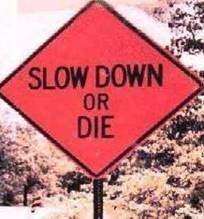 People who work excessive hours and refuse to take time off to slow down and recharge are not martyrs--they are fools.
Even God took a day off.
Just a thought.
BA
The Beginner's Mind.
Hi there,
This is a very useful technique when it comes to learning.
To quote wikipedia:
Shoshin (also pronounced nyuanshin) is a concept in Zen Buddhism meaning Beginner's Mind. It refers to having an attitude of openness, eagerness, and lack of preconceptions when studying a subject, even when studying at an advanced level, just as a beginner in that subject would. The term is especially used in the study of Zen Buddhism and Japanese martial arts.
The phrase was also used as the title of Zen teacher Shunryu Suzuki's book: Zen Mind, Beginner's Mind, which reflects a saying of his regarding the way to approach Zen practice: In the beginner's mind there are many possibilities, in the expert's mind there are few.
You can apply this in real life by approaching a subject with the mind of a beginner even if you feel you are already an expert! I remember such an example when I worked as a computer programmer. I had worked on a particular system for a few years and I really felt that "I knew it all". To be perfectly honest - I was a little bit arrogant about it! I then moved to another company who really pushed the system to it limits. I had a difficult time as I thought I knew it all and I was making lots of mistakes and my colleagues were surprised as they thought I knew it all too! If I had approached this new company with a "beginners mind", being honest with myself about what I actually knew, I would have caused less conflict and learnt much faster.
This technique can be applied in lots of areas of your life. Give it a go and you will be impressed by how much you will learn about the subject you are studying and yourself!
Good Luck,
Allen
This is a very useful technique when it comes to learning.
To quote wikipedia:
Shoshin (also pronounced nyuanshin) is a concept in Zen Buddhism meaning Beginner's Mind. It refers to having an attitude of openness, eagerness, and lack of preconceptions when studying a subject, even when studying at an advanced level, just as a beginner in that subject would. The term is especially used in the study of Zen Buddhism and Japanese martial arts.
The phrase was also used as the title of Zen teacher Shunryu Suzuki's book: Zen Mind, Beginner's Mind, which reflects a saying of his regarding the way to approach Zen practice: In the beginner's mind there are many possibilities, in the expert's mind there are few.
You can apply this in real life by approaching a subject with the mind of a beginner even if you feel you are already an expert! I remember such an example when I worked as a computer programmer. I had worked on a particular system for a few years and I really felt that "I knew it all". To be perfectly honest - I was a little bit arrogant about it! I then moved to another company who really pushed the system to it limits. I had a difficult time as I thought I knew it all and I was making lots of mistakes and my colleagues were surprised as they thought I knew it all too! If I had approached this new company with a "beginners mind", being honest with myself about what I actually knew, I would have caused less conflict and learnt much faster.
This technique can be applied in lots of areas of your life. Give it a go and you will be impressed by how much you will learn about the subject you are studying and yourself!
Good Luck,
Allen
The Beginner's Mind.
Hi there,
This is a very useful technique when it comes to learning.
To quote wikipedia:
Shoshin (also pronounced nyuanshin) is a concept in Zen Buddhism meaning Beginner's Mind. It refers to having an attitude of openness, eagerness, and lack of preconceptions when studying a subject, even when studying at an advanced level, just as a beginner in that subject would. The term is especially used in the study of Zen Buddhism and Japanese martial arts.
The phrase was also used as the title of Zen teacher Shunryu Suzuki's book: Zen Mind, Beginner's Mind, which reflects a saying of his regarding the way to approach Zen practice: In the beginner's mind there are many possibilities, in the expert's mind there are few.
You can apply this in real life by approaching a subject with the mind of a beginner even if you feel you are already an expert! I remember such an example when I worked as a computer programmer. I had worked on a particular system for a few years and I really felt that "I knew it all". To be perfectly honest - I was a little bit arrogant about it! I then moved to another company who really pushed the system to it limits. I had a difficult time as I thought I knew it all and I was making lots of mistakes and my colleagues were surprised as they thought I knew it all too! If I had approached this new company with a "beginners mind", being honest with myself about what I actually knew, I would have caused less conflict and learnt much faster.
This technique can be applied in lots of areas of your life. Give it a go and you will be impressed by how much you will learn about the subject you are studying and yourself!
Good Luck,
Allen
This is a very useful technique when it comes to learning.
To quote wikipedia:
Shoshin (also pronounced nyuanshin) is a concept in Zen Buddhism meaning Beginner's Mind. It refers to having an attitude of openness, eagerness, and lack of preconceptions when studying a subject, even when studying at an advanced level, just as a beginner in that subject would. The term is especially used in the study of Zen Buddhism and Japanese martial arts.
The phrase was also used as the title of Zen teacher Shunryu Suzuki's book: Zen Mind, Beginner's Mind, which reflects a saying of his regarding the way to approach Zen practice: In the beginner's mind there are many possibilities, in the expert's mind there are few.
You can apply this in real life by approaching a subject with the mind of a beginner even if you feel you are already an expert! I remember such an example when I worked as a computer programmer. I had worked on a particular system for a few years and I really felt that "I knew it all". To be perfectly honest - I was a little bit arrogant about it! I then moved to another company who really pushed the system to it limits. I had a difficult time as I thought I knew it all and I was making lots of mistakes and my colleagues were surprised as they thought I knew it all too! If I had approached this new company with a "beginners mind", being honest with myself about what I actually knew, I would have caused less conflict and learnt much faster.
This technique can be applied in lots of areas of your life. Give it a go and you will be impressed by how much you will learn about the subject you are studying and yourself!
Good Luck,
Allen
Wednesday, 28 February 2007
Choose your day
One of my very best friends (many say she is an angel) sent me this yesterday. I wanted to share it with you.
"Nothing is going to spoil this moment...Imagine making that decision: nothing's going to spoil this moment. Now, imagine making that decision about a relationship, job, day in the week,
or...whatever. Imagine applying that idea uniformly in your life."
--Neale Donald Walsch,
Author of Conversations with God.
She followed with her thoughts:
It is such a simple thing...This choosing to embrace the unspoiled in every aspect of our lives.
So simple, yet so profound. And it is a decision we each can choose to make.
May you decide to allow nothing to spoil this day.
om~peace~amen and may you be blessed
"Nothing is going to spoil this moment...Imagine making that decision: nothing's going to spoil this moment. Now, imagine making that decision about a relationship, job, day in the week,
or...whatever. Imagine applying that idea uniformly in your life."
--Neale Donald Walsch,
Author of Conversations with God.
She followed with her thoughts:
It is such a simple thing...This choosing to embrace the unspoiled in every aspect of our lives.
So simple, yet so profound. And it is a decision we each can choose to make.
May you decide to allow nothing to spoil this day.
om~peace~amen and may you be blessed
Subscribe to:
Posts (Atom)
Subscribe To


 Posts
All Comments
Posts
All Comments